

Introduction
Technology often gets labelled as a purely academic subject, something only for those who are great at math and logical thinking. Yet if you ask any experienced coding instructor, regardless of their background or area of focus in the tech industry, that couldn’t be further from the truth. Technology is a blend of both creative and technical skills. It’s logical thinking mixed with imagination. It’s problem-solving paired with curiosity. It is this mix that allows the most successful coders to think outside the box, build solutions that didn’t exist before and solve problems using technology.
When children learn coding at a young age, it gives them a completely new way to express themselves. Instead of just building their creativity through drawing with crayons or building with clay, children can now showcase these skills by creating animations, designing digital characters, or even exploring robotics in an increasingly digital world.
Coding in fact helps children develop their own creative style of thinking and build upon those exploration skills by developing an innate sense of curiosity, the key to long-term success.
Encouraging Exploration through Tech
In learning coding, students become more confident exploring their own ideas, week after week. In Scratch and Python lessons, they experiment, test, tweak, redesign, and debug their code. Students begin by following an instructor’s guidance, but eventually grow more confident and start to bring their own creative ideas to life by inventing their own games and features.
Coding instructors ensure the classroom feels playful and low-pressure. There are no “bad questions,” and students are encouraged to “break the code” to push boundaries and discover new outcomes. There’s rarely just one correct answer when coding, and it’s often a student’s creativity that leads them to the solution.
When things don’t work immediately, instead of frustration students build resilience as they are guided by instructors asking questions like:
- “What if you try this instead?”
- “What do you think will happen if you change the color?”
- “Could we make the character fly instead of walk?”
- “Is there another way to solve this?”
These moments help children develop:
- Imagination
- Independent thinking
- Confidence in experimenting
- Resilience when faced with challenges
How Students Learn Coding Through Creativity
In coding lessons, instead of students just copying code directly from the screen, they’re encouraged to build something meaningful to them, like a mini-game based on their favourite character. Along the way, they learn real software development habits: debugging, planning, testing, improving their work, and more.
Even Minecraft Education or more technical disciplines like robotics allow students to build upon their creative skills by building, designing and experimenting with these technologies in a fun and interactive way.
In Scratch (block coding) lessons, everything starts with a question:
“What do you want to make?”
From there, we explore how to bring their ideas to life, what blocks they’ll need, how characters behave, and how to solve problems when things go differently than expected. It’s learning through creativity, curiosity, and trial-and-error.
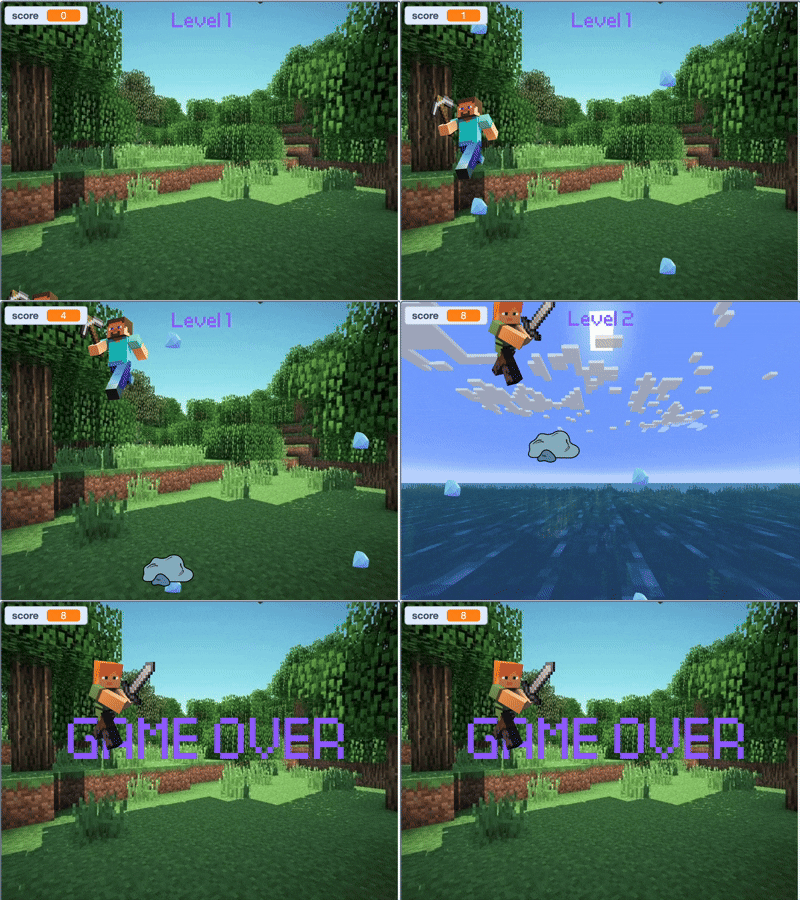

Students can customize their games in Scratch using their favorite characters and themes!
Technology isn’t only for children who excel in math or science – it’s a blend of academic and creative learning, and is for every child who has ideas, imagination, and curiosity. This is why technology is the new creative playground for children to both create and learn.