
Introduction
Technology often gets labelled as a purely academic subject, something only for those who are great at math and logical thinking. Yet if you ask any experienced coding instructor, regardless of their background or area of focus in the tech industry, that couldn’t be further from the truth. Technology is a blend of both creative and technical skills. It’s logical thinking mixed with imagination. It’s problem-solving paired with curiosity. It is this mix that allows the most successful coders to think outside the box, build solutions that didn’t exist before and solve problems using technology.
When children learn coding at a young age, it gives them a completely new way to express themselves. Instead of just building their creativity through drawing with crayons or building with clay, children can now showcase these skills by creating animations, designing digital characters, or even exploring robotics in an increasingly digital world.
Coding in fact helps children develop their own creative style of thinking and build upon those exploration skills by developing an innate sense of curiosity, the key to long-term success.
Learning Tech & STEM Skills in English
When children work on hands-on projects in English, they learn new technical skills and put their language skills to use. If they’re coding their own game, children might explain how the game should work, ask for help with an unfamiliar tool, or discuss a change to their design. This type of conversation helps them move their project forward and put their English skills to use in a natural context.
A 2025 review of primary-school research found that learning other subjects through a foreign language can support language development, particularly speaking skills. These findings give families a reason to consider opportunities to learn something interesting or hobby based in English.
Personally, I grew up attending an English-medium school in a country where English wasn’t the main language. For me, using English across several different subjects helped develop my English from a young age.
Even for children who already speak English comfortably, learning a new activity like programming or robotics offers them new contexts to put their language skills to use. Lessons include a combination of project work and English conversation, giving students opportunities to practise English while developing a new skill.
How to Choose an English-Speaking Activity Your Child Actually Wants to Join
Start by involving your child directly! Ask what they would like to make or learn, then explore suitable options in your community that are taught in English. A subject doesn’t have to be advanced to be a useful starting point. Even a casual interest in making a game or drawing a character can give kids more motivation than participating in an activity they don’t have an interest in. In a study of children aged 9–12, those given their preferred painting activity reported more interest and enjoyment than those assigned a nonpreferred one.
Parents can also ask how their child’s instructor adjusts the challenge to fit their level and learning goals. For me, I always aim to keep lesson tasks interesting without making them too overwhelming. Sometimes that means slowing down, using simpler English words and phrases, breaking a coding idea into smaller steps, or even changing the whole project. Children need room to try things themselves, but also get help when they are stuck.
Before starting a new activity in English, ask:
- What will my child actually make or do?
- How will the instructor adapt the activity to my child’s experience level?
- How much English does my child need, and what support is available?
- Would weekly or seasonal classes suit them better?
Weekly tech lessons give children time to return to a customized project over several sessions, and make consistent progress over time. On the other hand, a holiday tech camp that combines engaging STEM projects with other activities and outings can provide a unique environment for kids to learn while having fun.
What Can Children Create in English at Tokyo Coding Club?
In my own coding and game development lessons, we discuss the characters, story, and features before turning the students’ ideas into code. We plan, develop, and test, often going back to change something along the way. A 2024 review of controlled studies found improvements in children’s planning and problem-solving skills following coding activities. The finished project usually doesn’t tell the entire story on its own; rather, when a child shows you their work, they’ll have the chance to describe what they changed or found difficult along the way.
See below for a brief look at topics popular with students at Tokyo Coding Club, all of which are taught in English through either weekly private lessons, group classes, or seasonal camps.
Coding and Game Development
For many younger students, Minecraft is a place to get comfortable with a mouse and keyboard while moving around and building. As they gain experience, Minecraft projects can include “commands” or “Redstone,” the game’s system for building virtual circuits, such as making a door respond to a switch.
Children can also make games in Scratch using drag and drop code blocks, or try a simple project in Python when they’re ready for text-based coding. In Roblox Studio, they can build their own game worlds and add code to dictate how the game will behave. Students test their creations by playing them, asking if it works as intended, and what needs changing.
Robotics and Engineering
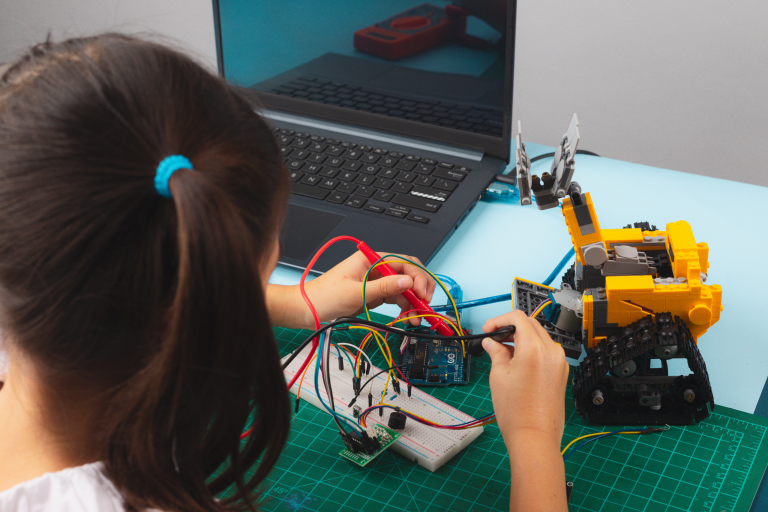
Robotics combines programming with physical components like circuitry and mechanics. Children might build a device and give it instructions to move or respond to a sensor. When their device behaves unexpectedly, students investigate if it’s the program, a connection, or the way the parts fit together.
Digital Art and Design
For children who enjoy drawing or inventing their own stories, projects like making a digital comic offer a great starting point for deepening their artistic and technical skills. In this project, students can design characters, plan scenes, and arrange them so others can follow the story. Along the way, they learn to use creative tools to develop their own ideas, with guidance when they need it.
At Tokyo Coding Club, families can explore coding, robotics, and digital design lessons, weekly group classes, and holiday STEM camps taught entirely in English. Curious to get started? Your child can try a free lesson to see what they enjoy. Reach out to us via info@tokyocodingclub.com, and a member of our team will help you find an activity that suits their interests and goals.